

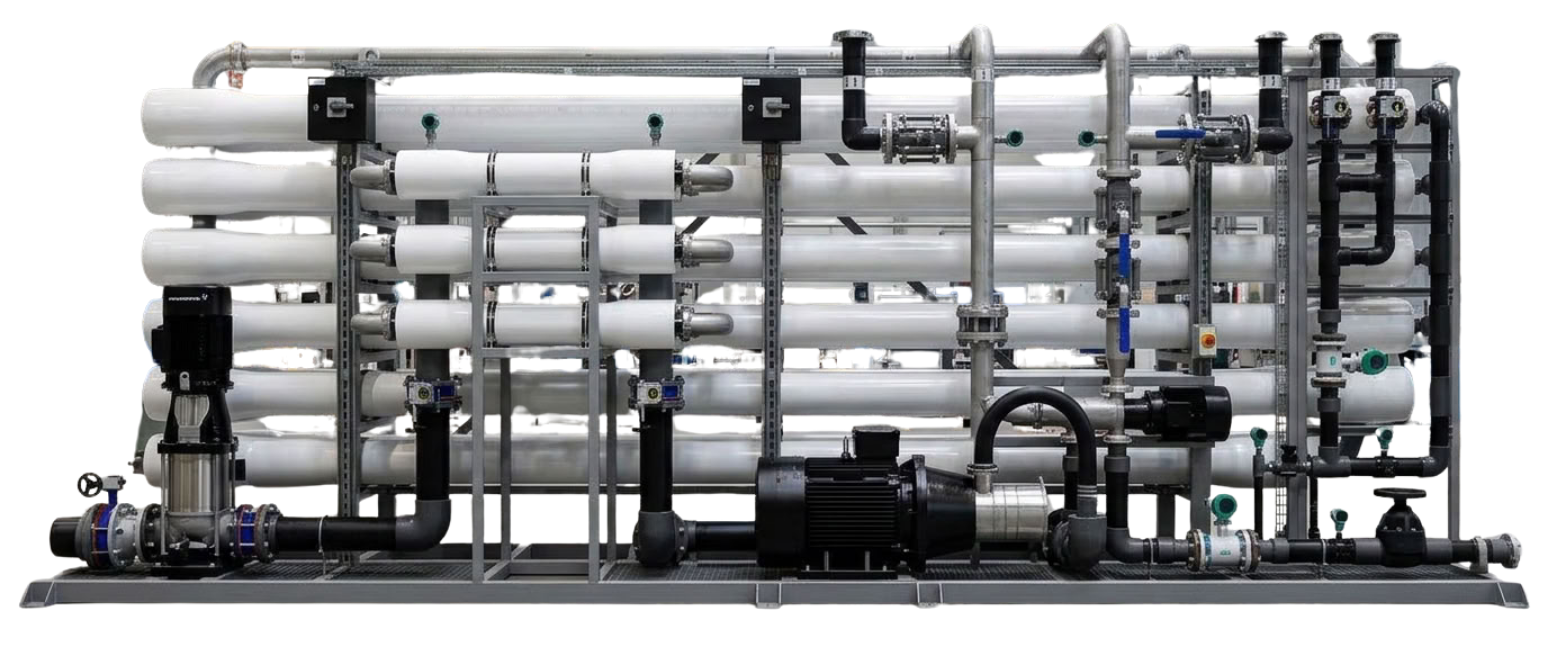
Overview
SWRO and BWRO in one minute
SWRO (Sea Water Reverse Osmosis) desalinates seawater of about 30,000 to 45,000 mg/L TDS at high pressure. BWRO (Brackish Water Reverse Osmosis) treats water of about 1,000 to 10,000 mg/L TDS at lower pressure. Both use the same principle, but pumps, membranes, pipework, pretreatment and brine handling are all different.
Selector
Which RO fits your salinity?
Move the slider to your feed TDS and watch what happens at the membrane. Or let the tour run: it also shows why a BWRO pump cannot make water from seawater.
SWRO
Typical industry ranges for orientation only. Osmotic pressure is shown as roughly 0.76 bar per 1,000 mg/L of dissolved salt, a simple approximation. In a real vessel the concentrate gets saltier along its length, so the pressure has to beat a higher osmotic pressure towards the outlet. Real design depends on temperature, ion makeup, scaling and fouling tendency, membrane choice and energy recovery.
Side by side
SWRO vs BWRO compared
| SWRO | BWRO | |
|---|---|---|
| Full form | Sea Water Reverse Osmosis | Brackish Water Reverse Osmosis |
| Feed TDS, typical | 30,000 to 45,000 mg/L | 1,000 to 10,000 mg/L |
| Operating pressure | About 55 to 70 bar | About 10 to 25 bar |
| Recovery | About 35 to 50% | About 70 to 90%, with staging |
| Energy | About 2.5 to 4 kWh/m³ | About 0.4 to 1.5 kWh/m³ |
| Energy recovery device | Standard on most plants | Rarely used |
| Pretreatment | Heavy: open intake fouling and biology | Moderate: hardness, silica and iron scaling |
| High-pressure piping | Duplex or super-duplex stainless steel is common | Stainless steel, or plastic at low pressure |
| Concentrate | About twice seawater salinity, usually returned to sea | Small volume, but disposal inland can be hard |
Treatment trains
What a typical train looks like
Switch between a brackish and a seawater skid and follow the water through. The skid is the same idea, but staging, pressure and energy recovery change.
BWRO skid
- 55 to 70 barTypical SWRO operating pressure.
- 10 to 25 barTypical BWRO operating pressure.
- About 2×SWRO concentrate salinity compared with seawater.
- SDI15 below 3 to 5Common feed target before the membranes.
Schematic and typical industry ranges only. Stage counts, vessel numbers, recovery and energy for a project come from the water analysis and the design calculation. Flow proportions in the drawing are illustrative.
SWRO train
- Intake: open or beach well
- Screening and coagulation
- Flotation or clarification
- Media filtration or ultrafiltration
- Cartridge filter and scale control
- High-pressure pump with energy recovery
- SWRO membranes
- Remineralisation, pH and disinfection
- Brine diffuser
BWRO train
- Well, or treated effluent, as source
- Multimedia, carbon or softener pretreatment, or UF
- Antiscalant dosing
- Cartridge filter
- BWRO stages in staged arrays
- Concentrate management or ZLD feed
- Permeate polishing
Field experience
What goes wrong
Feed water quality swings and biological growth foul membranes. A good intake and pretreatment cost less than repeated cleaning.
Calcium carbonate, calcium sulphate and silica limit recovery. Antiscalant and staging are set from the full ion analysis.
Chloride in seawater corrodes ordinary stainless steel, so high-pressure parts are usually duplex or super-duplex.
Low SDI and a known temperature range protect membranes and give a realistic energy figure.
Skids and containers
Pre-built RO skids for fast delivery
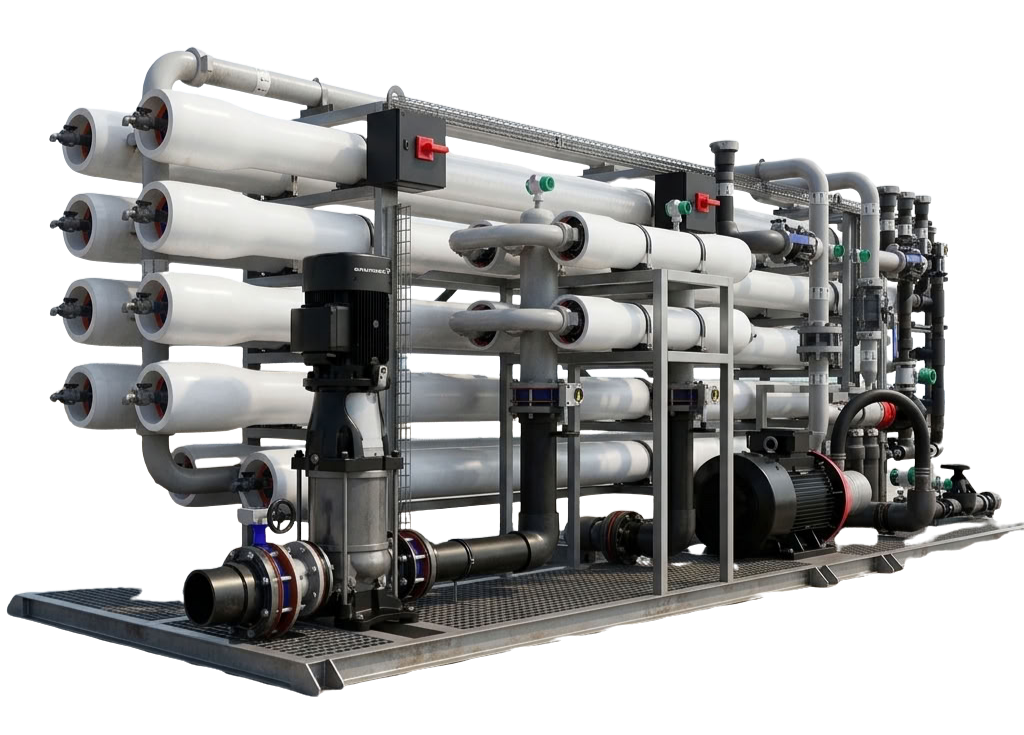
Skid mounted and containerised
Where a skid makes sense
A skid carries pumps, membranes, piping and controls on one frame. It is built and tested in the works and connected on site.
- Small and medium capacity plants
- Temporary, mobile or remote supply
- Faster installation and commissioning
Sizing an RO plant?
Send your feed water analysis and we will call you.
Thank you.
We have received your enquiry. Our team will contact you to discuss your plant and the next steps.
Prefer to talk first? WhatsApp us
Before a design
Data to send for an RO assessment
- Water source and flow needed, in m³/day
- Full water analysis: TDS, hardness, silica, iron, chloride, sulphate and others
- Temperature range through the year
- Turbidity and SDI, if available
- Product water target and use
- Site constraints and how concentrate can be disposed of
Quick answers
Frequently asked questions
SWRO stands for Sea Water Reverse Osmosis. It is a reverse osmosis plant designed for seawater, which is typically about 30,000 to 45,000 mg/L TDS, and it runs at high pressure, commonly about 55 to 70 bar.
BWRO (Brackish Water Reverse Osmosis) treats feed of roughly 1,000 to 10,000 mg/L TDS at lower pressure, usually about 10 to 25 bar, and can recover a high share of the feed as product water. SWRO treats seawater at much higher pressure, recovers a smaller share (typically 35 to 50 percent) and uses more energy per cubic metre. Membranes, pumps, pipework and pretreatment are all different.
No. BWRO membranes and pumps are not built for seawater salinity or the pressures it needs, so a BWRO plant cannot make drinkable water from seawater. Seawater needs SWRO membranes, high-pressure pumps and pressure-rated piping.
A SWRO skid is a pre-assembled frame carrying the high-pressure pump, energy recovery device, membrane vessels, piping, instruments and controls. It is built and tested in the factory and connected on site, which shortens installation time and suits small to medium plants, temporary supply and remote sites.
Typical figures are about 2.5 to 4 kWh per cubic metre of product water for seawater RO with energy recovery, against roughly 0.4 to 1.5 kWh per cubic metre for brackish water RO. Actual figures depend on feed salinity, temperature, recovery, membrane age and the energy recovery device.
The aim is to give the membranes feed with a low fouling tendency, commonly an SDI15 below 3 to 5. A typical train is an intake, screening, coagulation and flotation or clarification, then media filtration or ultrafiltration, cartridge filters, and dosing for scale and biological control. Intake quality drives how much is needed.
Concentrate from SWRO is usually about twice the seawater salinity and is returned to the sea through a diffuser designed for rapid mixing, where regulations permit. Inland brackish plants face a harder problem and may need evaporation ponds, deep-well disposal or a ZLD section.
SR Paryavaran supplies seawater and brackish water RO plants, including skid-mounted and containerised units, with pretreatment and post-treatment. The configuration is set from the feed water analysis and the product water requirement.
Need an RO plant sized for your water?
Share flow, source and target quality. An engineer will suggest SWRO, BWRO or a combination.
- A recommendation on SWRO, BWRO or a combination for your water
- Indicative pressure, recovery and energy for your feed
- A reply from an engineer, not a sales script
- Skid-mounted or containerised options where they suit
Prefer to talk? Call +91-90565-26208
Request an RO assessment
Thank you.
We have received your enquiry. Our team will contact you to discuss your plant and the next steps.
Prefer to talk first? WhatsApp us