

Overview
What is TSE water?
TSE water is treated sewage effluent — domestic and municipal sewage that has been through biological treatment, filtration and disinfection until it is suitable for non-potable reuse: landscape irrigation, cooling-tower make-up, construction, dust suppression and similar uses. The term is common in the Gulf, and the same water is described in India as treated sewage or treated wastewater for reuse.
SR Paryavaran Engineers designs sewage treatment plants and adds the tertiary filtration, UV disinfection and membrane polishing that turn plant effluent into reusable TSE water. We have delivered 6,000+ water and wastewater systems since 1990, manufacture our own MBR, UF and RO membranes, and support Gulf projects through our international office in Sharjah, UAE.
Treatment Process
How is TSE water produced from sewage?
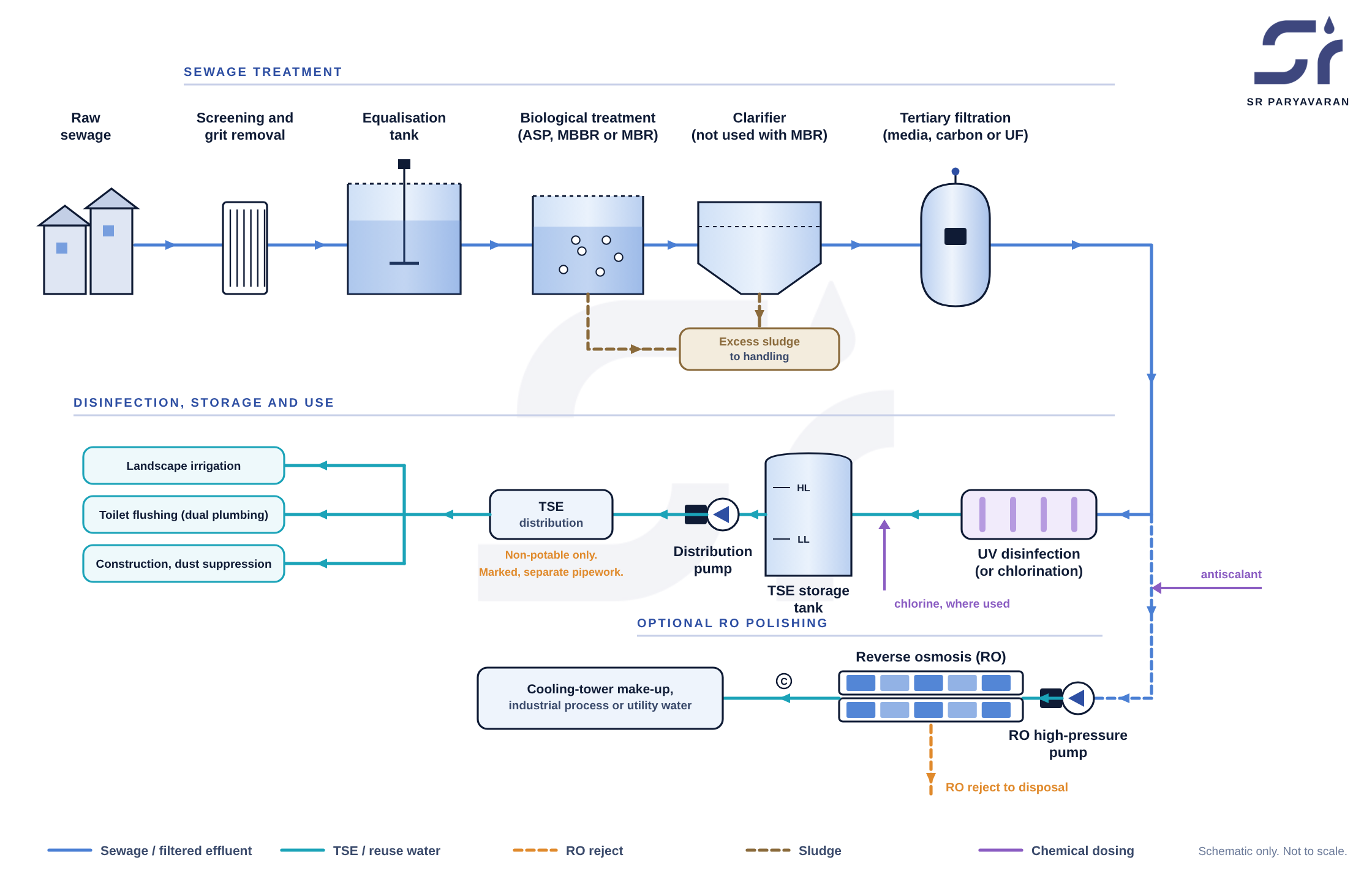
TSE production is a sewage treatment train with a reuse-grade finishing stage. The number of finishing stages depends on the end use.
Screening and grit removal
Removes rags, plastics and grit that damage pumps and blowers.
Equalisation
Buffers the daily flow and load peaks typical of sewage.
Biological treatment (ASP, MBBR or MBR)
Breaks down organic load and, where required, removes nitrogen. An MBR also replaces the clarifier and gives a cleaner effluent for reuse.
Tertiary filtration
Media or activated-carbon filtration, or ultrafiltration, for turbidity and fine solids.
Disinfection
UV or chlorination to control pathogens before storage and distribution. Required for all TSE uses.
Optional RO polishing
Where low salinity is needed, for example cooling-tower make-up or process use.
Applications
Where can TSE water be used?
TSE water is for non-potable use only. Permitted uses and their required quality are set by the local authority; the table shows the common categories and what each typically demands of the treatment plant.
| Use | What matters most | Typical finishing stage |
|---|---|---|
| Landscape and garden irrigation | Pathogen control, low odour, acceptable salinity for plants | Filtration + UV or chlorination |
| Cooling-tower make-up | Low scaling and fouling potential, low salinity | UF + RO polishing |
| Construction and dust suppression | Pathogen control, safe handling | Filtration + disinfection |
| Toilet flushing (dual plumbing) | Clarity, no odour, residual disinfectant | Filtration + disinfection |
| Industrial process or utility water | Consistent salinity and turbidity | UF + RO, see Tertiary Treatment |
Engineering Basis
What decides TSE water quality and plant design?
The numeric limits come from the regulator and the end use, so a TSE plant is designed to the specific authority's standard. These are the parameters that are normally specified.
Indicative values on a log scale. Actual limits depend on the authority and the end use.
| Parameter | Why it matters | How the plant controls it |
|---|---|---|
| BOD / COD | Odour, regrowth in storage and pipes | Biological stage sizing; MBR for tighter limits |
| Suspended solids and turbidity | Disinfection effectiveness, clogging of irrigation emitters | Tertiary filtration or UF |
| Pathogens (coliforms) | Public health risk from spray and contact | UV or chlorination, with residual where needed |
| Nitrogen and phosphorus | Algae growth in storage; plant nutrition for irrigation | Nitrification-denitrification in the biological stage |
| TDS / salinity | Soil and plant tolerance; cooling-tower scaling | RO polishing or blending |
| Residual chlorine | Keeps distributed water safe; harmful to some plants at high levels | Dose control with online monitoring |
What SRPEPL Supplies
TSE water systems from SR Paryavaran Engineers
We supply the full chain from sewage to reuse-grade water: the sewage treatment plant, tertiary filtration and UV disinfection, optional UF and RO polishing, controls and monitoring, and long-term operation and maintenance.
For Gulf projects our international office in Sharjah, UAE supports pre-sales, coordination and after-sales. See also Water Treatment Technologies and containerised plants for fast-deploy options.
Frequently Asked Questions
TSE water — common questions
TSE water is treated sewage effluent: municipal or campus sewage that has been through biological treatment, filtration and disinfection so that it can be reused for non-potable purposes such as landscape irrigation, cooling-tower make-up, construction and dust suppression. The term is widely used in the Gulf region.
No. TSE water is intended for non-potable uses only. It is not treated or approved as drinking water, and should be kept separate from potable supply, with clear pipe marking and signage.
Raw sewage passes through screening and grit removal, then biological treatment such as activated sludge, MBBR or MBR. The effluent is then polished by filtration and disinfected by UV or chlorination. Where higher quality is required, ultrafiltration and reverse osmosis are added.
Treated sewage effluent refers specifically to water from sewage, which is domestic and municipal wastewater. Treated wastewater is a broader term that also covers industrial effluent. Industrial effluent is treated in an effluent treatment plant (ETP) and has different contaminants, so the treatment train differs. See Effluent Treatment Plants.
The standard depends on the country, the regulator and the end use. Irrigation, cooling and construction uses each carry different limits for parameters such as BOD, suspended solids, turbidity and pathogens. A TSE plant should be designed to the specific authority's standard for the intended use.
Yes. SR Paryavaran Engineers designs sewage treatment plants and adds tertiary filtration, UV disinfection and membrane polishing so that the effluent meets reuse quality. The company supports projects in India and across the Gulf through its international office in Sharjah, UAE. See the Sewage Treatment Plant page.
Planning a TSE water or sewage reuse project?
Share the sewage flow, the intended use of the treated water and the local authority's quality requirement. Our engineers will propose a treatment train and finishing stages.
Related Solutions