

What is UV disinfection?
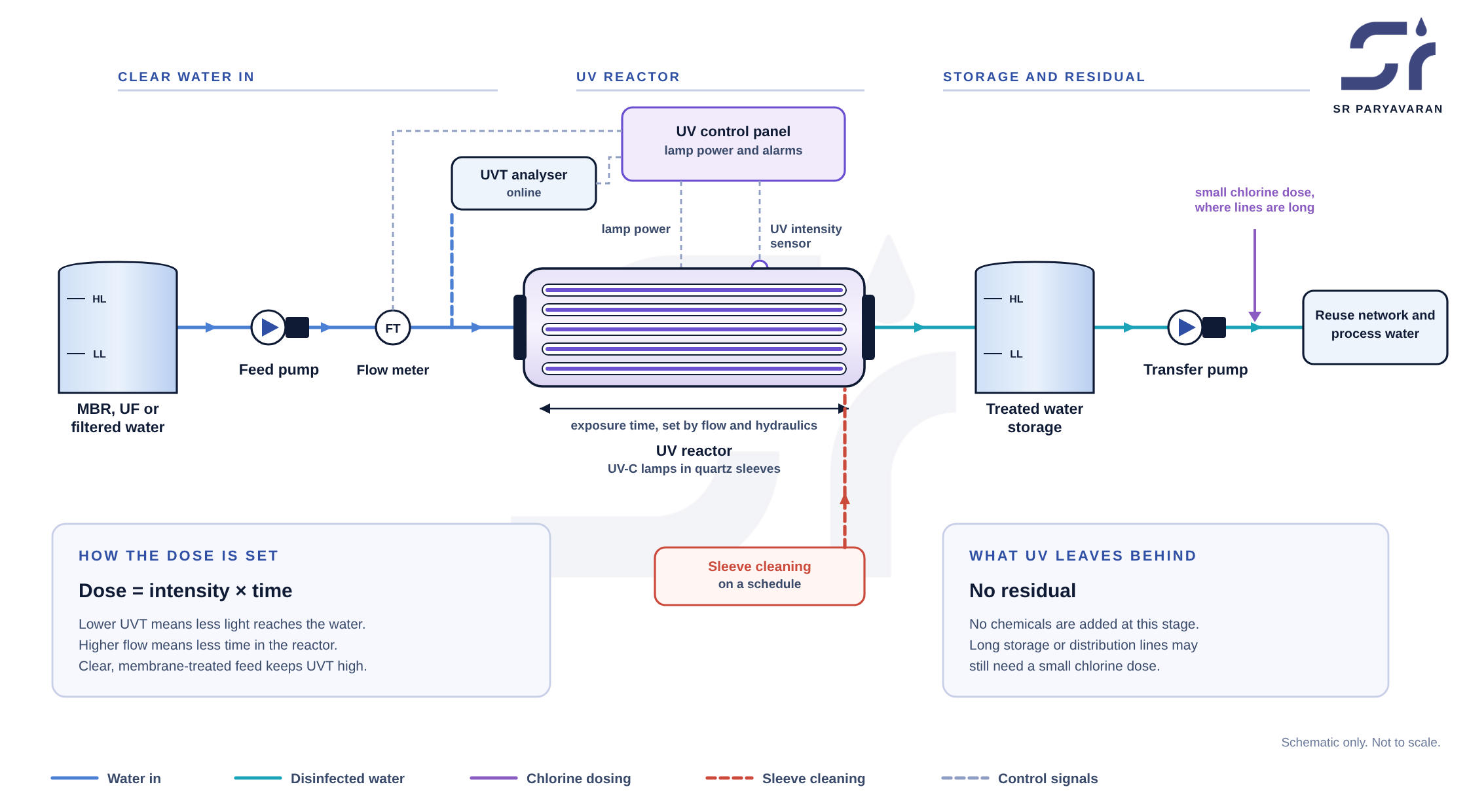
UV disinfection inactivates bacteria, viruses and protozoa by exposing water to UV-C light, with no chemical dosing. It is the usual final stage for treated sewage effluent, reuse water and many process-water systems.
SR Paryavaran Engineers specifies UV as the last barrier after biology, MBR or UF, on EPC, DBO or O&M terms.
Why transmittance decides the dose
Move the slider: the cloudier the water, the less light reaches the far side of the reactor.
Illustrative Beer–Lambert decay, intensity = UVTdistance. Real reactors are sized with validated dose models.
What sets the reactor size
Sizing starts from the water and the microbial target.
| Parameter | What it governs | Why it matters |
|---|---|---|
| Flow and peak flow | Number of lamps and reactor size | Contact time falls as flow rises, so peaks decide the design. |
| UV transmittance (UVT) | Delivered dose | Lower UVT means less light reaches the water, so more lamps are needed. |
| Turbidity and suspended solids | Shielding of microorganisms | Particles can shield organisms, which is why UV follows membranes or filtration. |
| Target organism and log reduction | Required dose | Different organisms need different doses; the target comes from the reuse standard. |
| Lamp type and sleeve fouling | Output over time | Fouling and ageing reduce output, so design uses an end-of-life margin. |
| Residual requirement | Need for a chemical backup | UV leaves no residual, so long storage lines may need a small chlorine dose. |
UV, chlorine or both?
| Option | Strength | Limitation | Typical use |
|---|---|---|---|
| UV-C | Fast, chemical-free; no chlorinated by-products from this stage | No residual; needs low-turbidity water | Final stage after MBR / UF / filtration |
| Chlorine / hypochlorite | Leaves a residual; low capital cost | By-products with organics; contact tank needed | Distribution lines and storage |
| UV plus residual chlorine | Primary kill by UV, residual by a small chlorine dose | Two systems to run | Reuse networks with long lines |
| Ozone | Strong oxidant | Higher capex and energy; no lasting residual | Specific polishing duties |
Where UV is used
From reuse networks to process water.
How SRPEPL delivers UV disinfection
Six steps from water data to a reactor that delivers its dose.
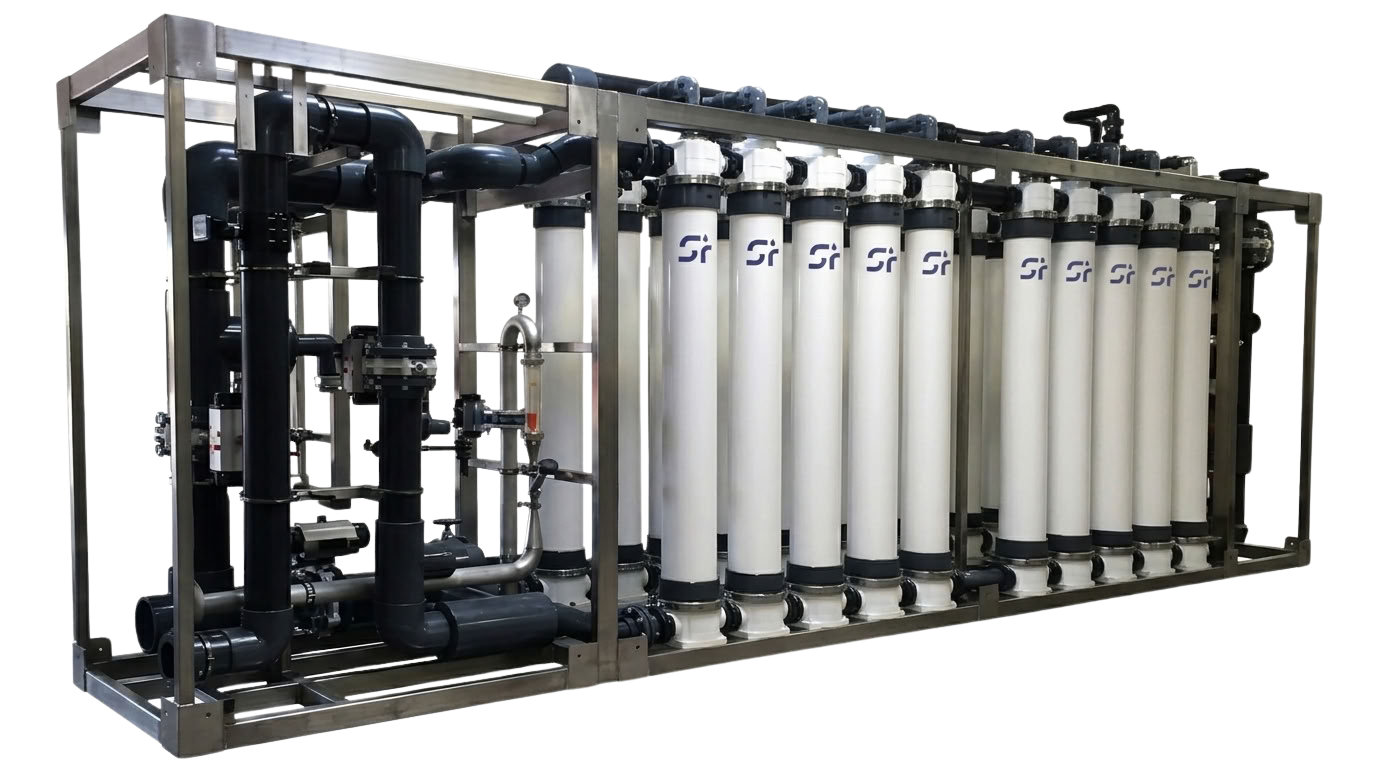
Engineering backed by manufacturing
Frequently Asked Questions
UV Disinfection — common questions
UV disinfection exposes water to ultraviolet-C light, typically around 254 nm, which damages the DNA of bacteria, viruses and protozoa so they cannot reproduce. It adds no chemicals to the water.
Dose is the UV intensity multiplied by the exposure time. It depends on lamp output, reactor hydraulics, flow rate and, most of all, the UV transmittance of the water, which falls when the water is turbid or coloured.
UV light needs to pass through the water. Membrane-treated water is very low in turbidity and suspended solids, so UV delivers its design dose reliably and with smaller reactors.
No. UV inactivates microorganisms as the water passes the lamps but leaves no residual. Where the water is stored or distributed over long lines, a small chlorine dose may still be added to maintain a residual.
Lamp output declines with use, so lamps are replaced after their rated life, and quartz sleeves are cleaned periodically to remove fouling. The interval depends on the lamp type and water quality; the manufacturer rating applies.
Yes. UV disinfection is included as the final stage in sewage, TSE, reuse and process-water trains, sized from the measured water quality and delivered on EPC, DBO or O&M terms.
Send your water data for a UV assessment
Share the flow, UV transmittance, turbidity and the microbial target. Our engineers will size the reactor and confirm where it sits in the train.
Related