



Overview
What is a containerised water treatment plant?
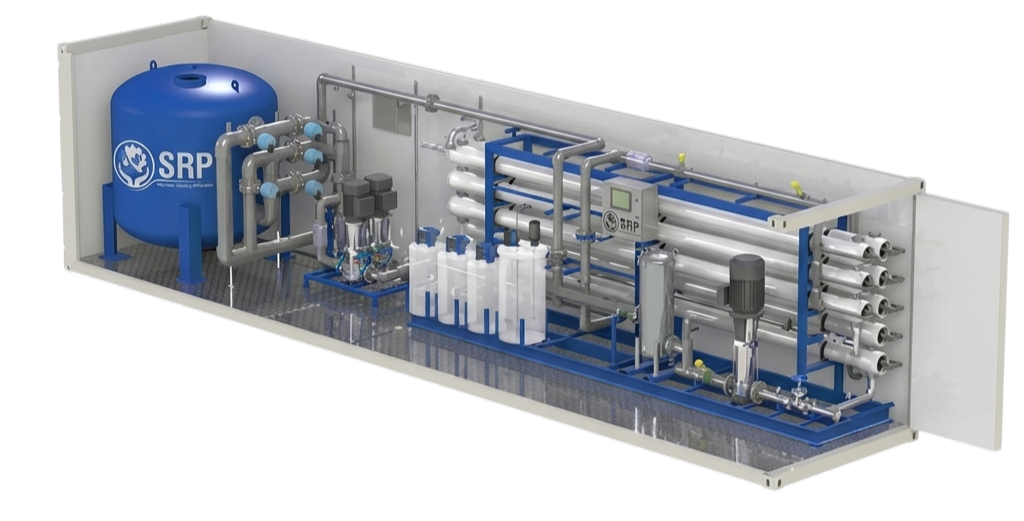
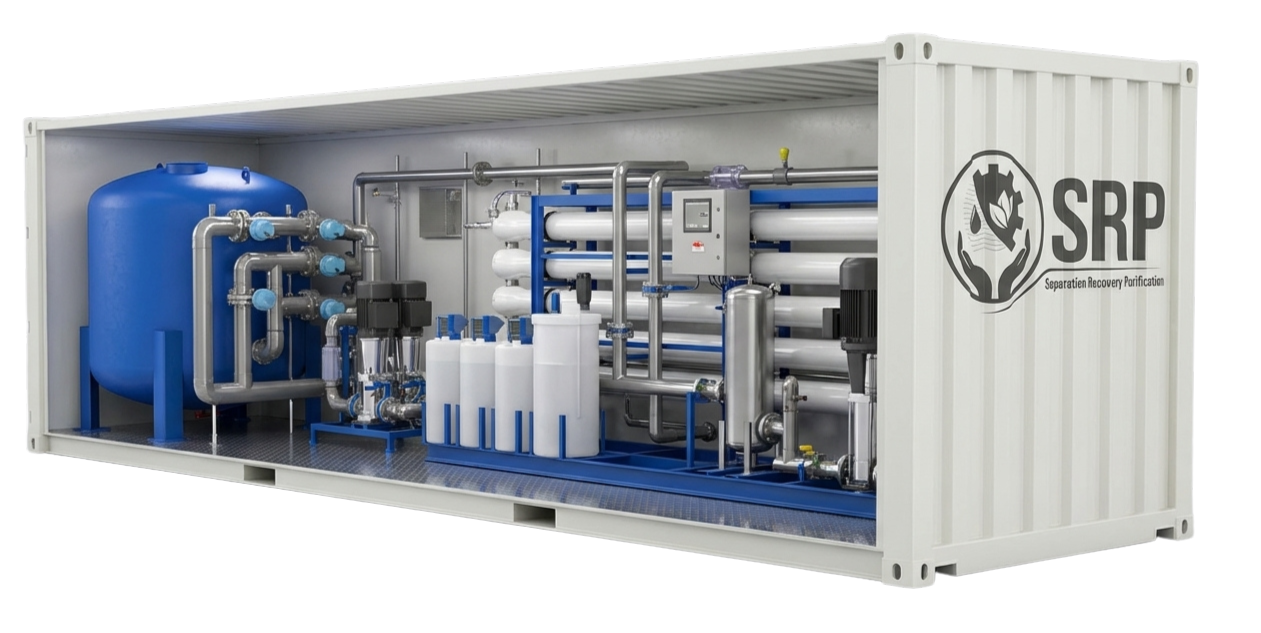
A containerised or skid-mounted water treatment plant is a complete treatment system — pre-treatment, membrane filtration (UF, brackish-water RO or seawater RO), post-treatment and controls — engineered and assembled inside an ISO shipping container or fabricated skid frame at the factory, then shipped to site ready for power, feed-water and product-water connections.
SR Paryavaran Engineers designs, manufactures, assembles, factory-tests and commissions these plants across seven standard capacity tiers from 1 to 50 m³/hr (24 to 1,200 CMD). We manufacture our own UF, RO and MBR membrane elements in Panchkula, India — and have delivered more than 4,000 packaged systems, including supplies to US Military installations through KBR and decentralised rural drinking-water programmes across India serving thousands of communities.
Decision Guide
When is a containerised plant the right choice?
Containerised and skid-mounted plants are the correct choice when the site needs rapid deployment, relocatability, or operation in infrastructure-constrained environments — defence and paramilitary installations, remote industrial sites, construction camps, export projects, disaster relief, and decentralised rural drinking-water schemes.
A conventional civil plant takes 9–18 months from order to commissioning and cannot be relocated. A packaged plant of equivalent capacity is factory-built in weeks, shipped as one or more ISO containers, and commissioned on site in days.
Product Range
Containerised configurations offered
Three primary configurations — containerised BWRO, SWRO and UF — each across seven standard capacity tiers. The treatment train is engineered per project from feed-water analysis and product-water specification.
| Capacity | CMD | Feed TDS | Recovery | Housing | Membrane |
|---|---|---|---|---|---|
| 1 m³/hr | 24 | ≤10,000 mg/L | 75–85% | Skid / 10ft | SRP BW4040 |
| 2.5 m³/hr | 60 | ≤10,000 mg/L | 75–85% | 20ft | SRP BW8040 |
| 5 m³/hr | 120 | ≤10,000 mg/L | 75–85% | 20ft | SRP BW8040 |
| 10 m³/hr | 240 | ≤10,000 mg/L | 75–85% | 20ft / 40ft | SRP BW8040 |
| 15 m³/hr | 360 | ≤10,000 mg/L | 75–85% | 40ft | SRP BW8040 |
| 25 m³/hr | 600 | ≤10,000 mg/L | 75–85% | Multi-container | SRP BW8040 |
| 50 m³/hr | 1,200 | ≤10,000 mg/L | 75–85% | Multi-container | SRP BW8040 |
| Capacity | CMD | Feed TDS | Recovery | Housing | Membrane |
|---|---|---|---|---|---|
| 1 m³/hr | 24 | ≤45,000 mg/L | 50–60% | 20ft | SRP SW8040 |
| 2.5 m³/hr | 60 | ≤45,000 mg/L | 50–60% | 20ft | SRP SW8040 |
| 5 m³/hr | 120 | ≤45,000 mg/L | 50–60% | 20ft / 40ft | SRP SW8040 |
| 10 m³/hr | 240 | ≤45,000 mg/L | 50–60% | 40ft | SRP SW8040 |
| 15 m³/hr | 360 | ≤45,000 mg/L | 50–60% | 40ft / Multi | SRP SW8040 |
| 25 m³/hr | 600 | ≤45,000 mg/L | 50–60% | Multi-container | SRP SW8040 |
| 50 m³/hr | 1,200 | ≤45,000 mg/L | 50–60% | Multi-container | SRP SW8040 |
| Capacity | CMD | Feed Quality | Permeate | Housing | Membrane |
|---|---|---|---|---|---|
| 1 m³/hr | 24 | TDS <800 mg/L | <0.1 NTU | Skid / 10ft | SRP ULTRAFLO |
| 2.5 m³/hr | 60 | TDS <800 mg/L | <0.1 NTU | 20ft | SRP ULTRAFLO |
| 5 m³/hr | 120 | TDS <800 mg/L | <0.1 NTU | 20ft | SRP ULTRAFLO |
| 10 m³/hr | 240 | TDS <800 mg/L | <0.1 NTU | 20ft / 40ft | SRP ULTRAFLO |
| 25 m³/hr | 600 | TDS <800 mg/L | <0.1 NTU | Multi-container | SRP ULTRAFLO |
| 50 m³/hr | 1,200 | TDS <800 mg/L | <0.1 NTU | Multi-container | SRP ULTRAFLO |
Standard Equipment
What's inside a standard containerised plant?
Every SRPEPL containerised plant is delivered as a complete, factory-tested system. The scope covers the full treatment train, instrumentation, controls, chemical dosing and container engineering — adapted per BWRO, SWRO or UF duty.
Deployed References
Where has SRPEPL deployed containerised plants?
More than 4,000 packaged UF and RO systems delivered since 1990 — across defence, industrial, export and community drinking-water programmes. The principal reference programmes are listed below.
| Client / Programme | Scope | Geography |
|---|---|---|
| KBR / US Military | Multiple containerised BWRO and SWRO skids for military bases. DPAS-rated priority orders, air-freighted to active military theatres. | Afghanistan, Uzbekistan |
| Synergy Gases | Containerised WTP for industrial facility | Mombasa, Kenya |
| Maharashtra — Solar WTPs | 108 solar-powered packaged RO plants for off-grid rural deployment | Maharashtra, India |
| Punjab Rural Water Supply | ~1,200 packaged RO plants (250–5,000 LPH) for village-level drinking-water supply | Punjab, India |
| Punjab Fluoride Mitigation | ~1,070 decentralised community units including 226 fluoride-mitigation units targeting high-fluoride groundwater zones | Punjab, India |
| Rajasthan PHED | 600+ village UF + RO community plants, including 225 across six districts under PHED programme | Rajasthan, India |
| RDWSD Karnataka | 582 RO/UF installations under Design-Build-Operate-Transfer (DBOT) model | Karnataka, India |
Community Programmes
Community & rural drinking-water plants
A significant share of SRPEPL's 4,000+ packaged systems are decentralised, village-level or block-level packaged RO, UF and fluoride-removal units — typically 250 to 5,000 LPH — designed to treat local groundwater or surface water to IS 10500:2012 potable standards.
International Supply
Export markets — GCC, Africa, Southeast Asia
Containerised plants are factory-built at Panchkula, Haryana and shipped from Indian ports — ICD Ludhiana for inland stuffing, Nhava Sheva and Mundra for ocean freight — to the Gulf, East and West Africa and Southeast Asia. ISO-standard housings handle sea freight and multi-modal logistics. Commissioning at the destination requires only power, feed-water and product-water connections.
Contract Scope
What does SRPEPL's scope include?
Standard scope includes
Enquiry Process
How does SRPEPL prepare a containerised plant proposal?
To prepare a site-specific treatment train and commercial proposal, SRPEPL requires four inputs. With these inputs, the engineering team maps the treatment train, selects membrane configuration, sizes pre-treatment and post-treatment stages, and produces a technical proposal with a general arrangement drawing and commercial offer.
Differentiators
Why is SRPEPL chosen for containerised and packaged plants?
Frequently Asked Questions
Containerised & skid-mounted water treatment plants
SRPEPL manufactures containerised and skid-mounted plants across seven standard capacity tiers: 1 m³/hr, 2.5 m³/hr, 5 m³/hr, 10 m³/hr, 15 m³/hr, 25 m³/hr and 50 m³/hr — equivalent to 24 to 1,200 CMD. Single-container delivery is standard up to approximately 10–15 m³/hr in a 20ft or 40ft ISO container. Capacities from 15 to 50 m³/hr are delivered as multi-container or multi-skid assemblies. Capacities above 50 m³/hr are engineered on a per-project basis.
BWRO (brackish water RO) plants treat feed water with TDS up to 10,000 mg/L, operate at 15–30 bar and achieve 75–85% recovery. SWRO (seawater RO) plants treat feed water with TDS up to 45,000 mg/L, operate at 55–70 bar and achieve 50–60% recovery. SWRO plants require higher-pressure pumps, heavier pressure vessels, energy recovery devices and UF pre-treatment as standard — making the SWRO container physically larger and more costly per unit capacity than BWRO. SRPEPL manufactures both SRP BW-series and SRP SW-series membrane elements in India.
Yes. SRPEPL has supplied multiple containerised BWRO and SWRO skids to US Military installations through KBR in Afghanistan and Uzbekistan — DPAS-rated priority orders, air-freighted to active military bases. This is one of the most demanding procurement environments globally, requiring full supply-chain traceability, factory acceptance testing to US Department of Defense standards, and documentation that meets defence-grade QA/QC requirements.
Yes. SRPEPL has delivered thousands of decentralised community drinking-water plants under state government programmes — approximately 1,200 packaged RO plants and approximately 1,070 decentralised units (including 226 fluoride-mitigation units) in Punjab, more than 600 village UF + RO plants in Rajasthan, 582 RO/UF installations under DBOT in Karnataka, and 108 solar-powered RO plants in Maharashtra. These plants produce water compliant with IS 10500:2012 and are typically operated under multi-year O&M or DBOT contracts.
DBOT stands for Design-Build-Operate-Transfer. Under this contract structure, SRPEPL designs, manufactures, installs and operates the community water treatment plants for a contracted concession period before transferring the assets to the state government or utility. The DBOT model places technology risk, O&M performance and membrane-replacement responsibility on the contractor for the full concession term. SRPEPL has executed 582 DBOT installations for the Rural Drinking Water and Sanitation Department, Karnataka.
Yes. Fluoride above the 1.5 mg/L limit specified by IS 10500:2012 is endemic across parts of Punjab, Rajasthan, Andhra Pradesh, Telangana and other Indian states. SRPEPL has deployed approximately 226 fluoride-mitigation units in Punjab specifically targeting high-fluoride groundwater zones. These units use RO and/or adsorption-based fluoride removal to bring treated water below the permissible limit. Containerised configurations make fluoride-mitigation plants practical for village-level deployment where centralised supply infrastructure does not exist.
Yes. SRPEPL manufactures UF, RO and MBR membrane elements at two facilities — Panchkula, Haryana and HPSIDC Baddi, Himachal Pradesh. Containerised plants use SRP BW-series (brackish RO), SRP SW-series (seawater RO) and SRP ULTRAFLO (UF) membranes — all manufactured in-house. This vertical integration ensures quality control, supply-chain independence and lifecycle support from a single source. For full membrane product specifications, visit srpmembranes.com.
Yes. Containerised plants are one of SRPEPL's primary export products. Systems are factory-built at Panchkula and shipped from Indian ports (ICD Ludhiana, Nhava Sheva, Mundra) to the Gulf, East and West Africa and Southeast Asia. SRPEPL operates an international office in Sharjah, UAE, supporting export projects across the GCC, Africa and Southeast Asia. Named export references include containerised WTP for Synergy Gases in Mombasa, Kenya, and containerised skids supplied to US Military installations through KBR.
All SRPEPL community and rural drinking-water plants are designed to produce treated water compliant with IS 10500:2012 (Bureau of Indian Standards drinking water specification). For export markets, plants are engineered to comply with WHO Guidelines for Drinking-water Quality. Compliance documentation, including periodic water-quality test reports, is a standard deliverable for all community plant contracts.
For a containerised water treatment plant enquiry, use the enquiry form on our Contact page, email info@srpepl.com, call or WhatsApp +91 98759 55948, or reach our Sharjah office at sidhant@srpepl.com for export-market enquiries. To prepare a site-specific proposal, we need four inputs: a feed-water analysis report, the required product-water specification, the required capacity, and the site location and logistics context.
Request a containerised plant proposal
Share your feed-water analysis, required product-water quality, capacity and site location. Our engineering team will map the treatment train and prepare a technical proposal with general arrangement drawing and commercial offer.