

What is dissolved air flotation?
Dissolved air flotation (DAF) removes suspended solids, oil, grease and fibres from water by attaching fine air bubbles to them so that they float to the surface and can be skimmed off. It is used where the material to be removed is light, oily or finely dispersed and does not settle well in a conventional clarifier.
SR Paryavaran Engineers builds ETPs and CETPs across food, dairy, textile, paper, chemical and oil-and-gas effluent, and includes DAF in the train where the feed carries oil, fat or fibre. Delivery is on EPC, DBO or O&M terms.
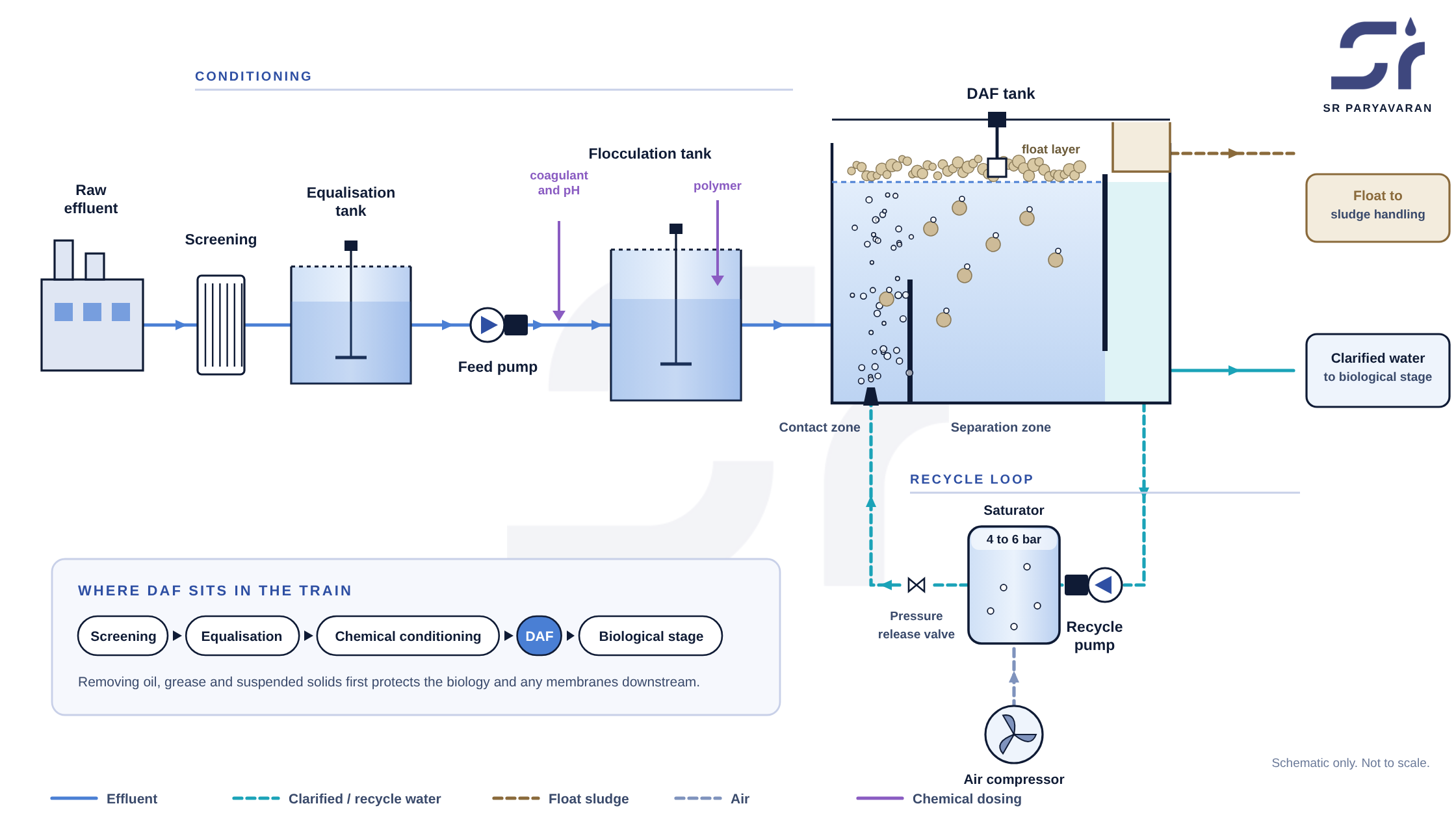
Watch the bubbles lift the solids
Flotation only works when the particles are conditioned to meet the bubbles. That is why the chemical step matters as much as the air system.
- 4 to 6 barTypical saturation pressure of the recycle
- Coagulant, pH, polymerConditioning, with doses set by jar test on your effluent
- Surface loadingThe main sizing basis for the tank
- Thicker than settledFloat sludge is easier to dewater
Pressures and doses are typical ranges, not guarantees. The design basis comes from the measured effluent and jar tests. The animation is a schematic with compressed time.
What sets the size of a DAF unit
The design starts from the effluent, not from a catalogue size.
| Parameter | What it governs | Why it matters |
|---|---|---|
| Flow and peak flow | Tank surface area | Surface loading is the main sizing basis, so peaks and equalisation decide the unit. |
| Oil, grease and TSS load | Float sludge volume and chemical dose | Heavier loads need more skimming capacity and a larger chemical programme. |
| Recycle ratio and saturation pressure | Air supply to the tank | Typically a pressurised recycle of 4–6 bar; the recycle ratio is set to supply enough air per kg of solids. |
| Chemical conditioning | Floc strength and bubble attachment | Coagulant, pH and polymer are set by jar testing on the actual effluent. |
| Effluent temperature and fats | Float quality | Fats behave differently when warm, which affects skimming and sludge handling. |
| Downstream duty | Required removal | If the next stage is biological or membrane, the DAF target is set to protect it. |
DAF, clarifier or API separator?
| Option | Removes | Best for | Limitation |
|---|---|---|---|
| Primary clarifier (sedimentation) | Heavy, settleable solids | Mineral and dense solids | Poor on oil, fat and light flocs |
| API / oil separator | Free, floating oil | Refinery and workshop effluent with free oil | Does not remove emulsified oil or fine solids |
| DAF | Light solids, oil, grease, fibres, flocculated colloids | Food, dairy, meat, edible oil, textile, paper, chemical effluent | Needs chemical conditioning; does not remove dissolved COD |
| Lamella clarifier | Settleable flocs in a compact footprint | Space-constrained sites with heavier solids | Light and oily solids still float rather than settle |
Where DAF is used
The same unit principle, tuned to each effluent.
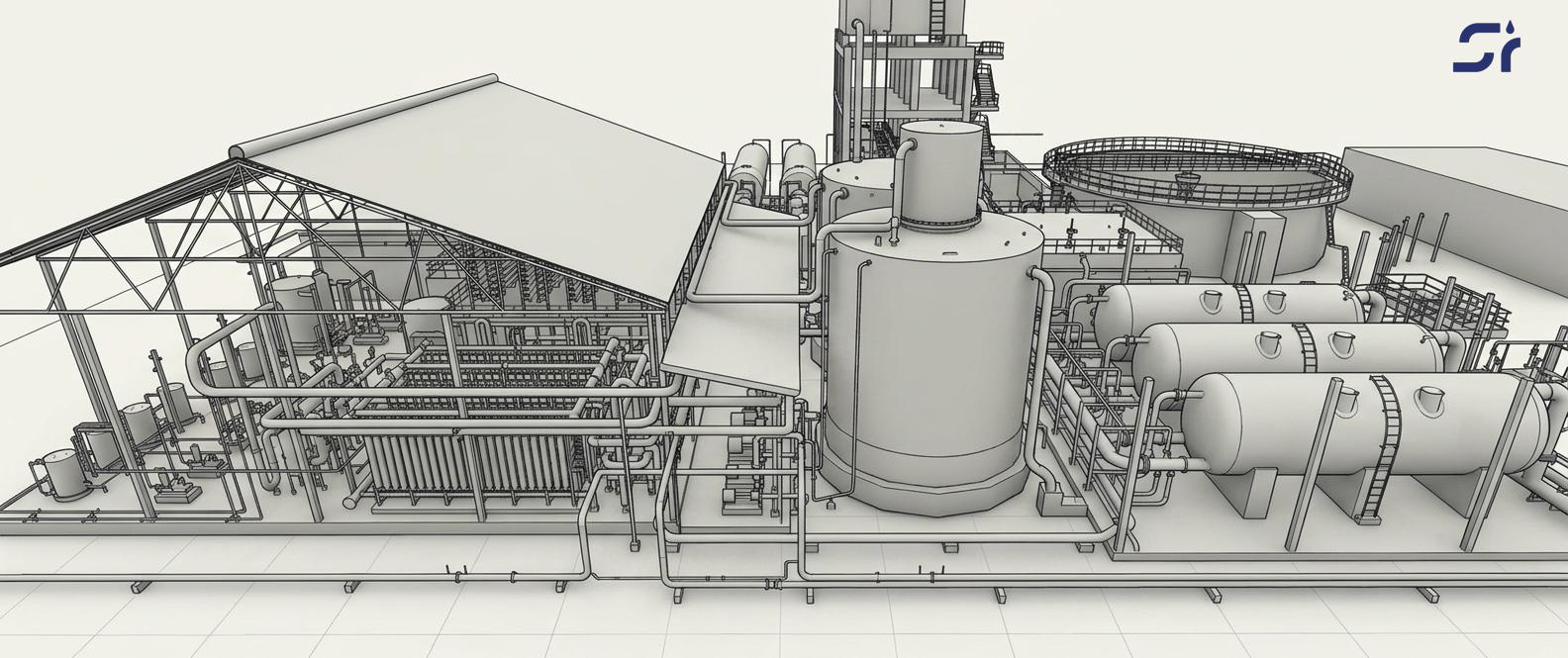
How SRPEPL delivers a DAF system
Six steps from your effluent data to a unit that holds its performance.
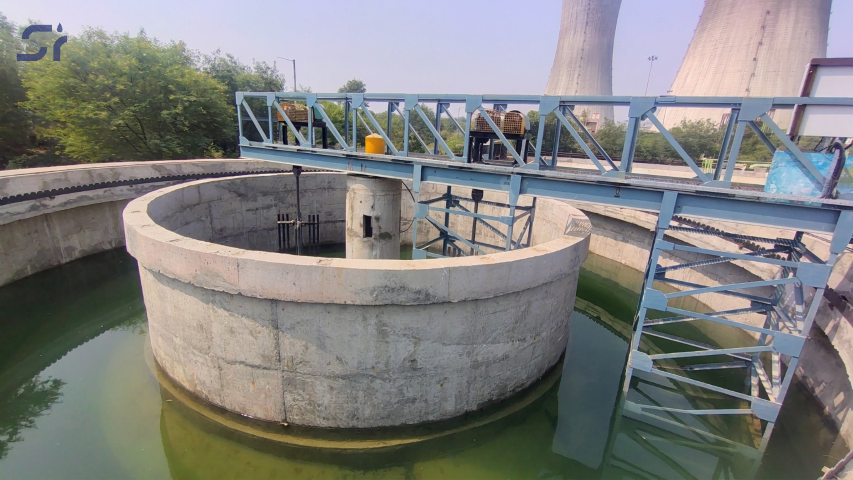
Engineering backed by manufacturing
Frequently Asked Questions
Dissolved Air Flotation (DAF) — common questions
Dissolved air flotation is a physical treatment process that removes suspended solids, oil, grease and fibres from water. Air is dissolved in a pressurised recycle stream and released in the flotation tank as fine bubbles that attach to the particles and lift them to the surface, where a skimmer removes the float as sludge.
A DAF system removes suspended solids, oil and grease, fats and fibres, and with chemical conditioning it also removes part of the colloidal COD and phosphorus. It does not remove dissolved organics or salts, so it is normally followed by a biological stage and, for reuse, by membranes.
Choose DAF when the solids are light, oily or finely dispersed and settle poorly, which is common in food, dairy, meat, edible oil, textile and paper effluent. Sedimentation suits heavy mineral solids; DAF handles low-density solids and gives a thicker float sludge.
DAF normally sits after screening, equalisation and chemical conditioning (coagulant and polymer dosing) and before the biological stage. Removing oil, grease and suspended solids first protects the biology and any downstream membranes from fouling.
Most industrial DAF units use a coagulant such as alum or ferric salts, pH correction and a polymer flocculant so that fine particles form flocs that the bubbles can carry. Doses are set by jar testing on the actual effluent.
Yes. SR Paryavaran Engineers includes DAF in effluent treatment plants where oil, grease or fibre loads require it, designed against the measured effluent and delivered on EPC, DBO or O&M terms.
Send your effluent data for a DAF assessment
Share the flow, oil and grease, TSS and COD of your effluent and the discharge or reuse target. Our engineers will advise whether DAF is needed and where it sits in the train.
Related