

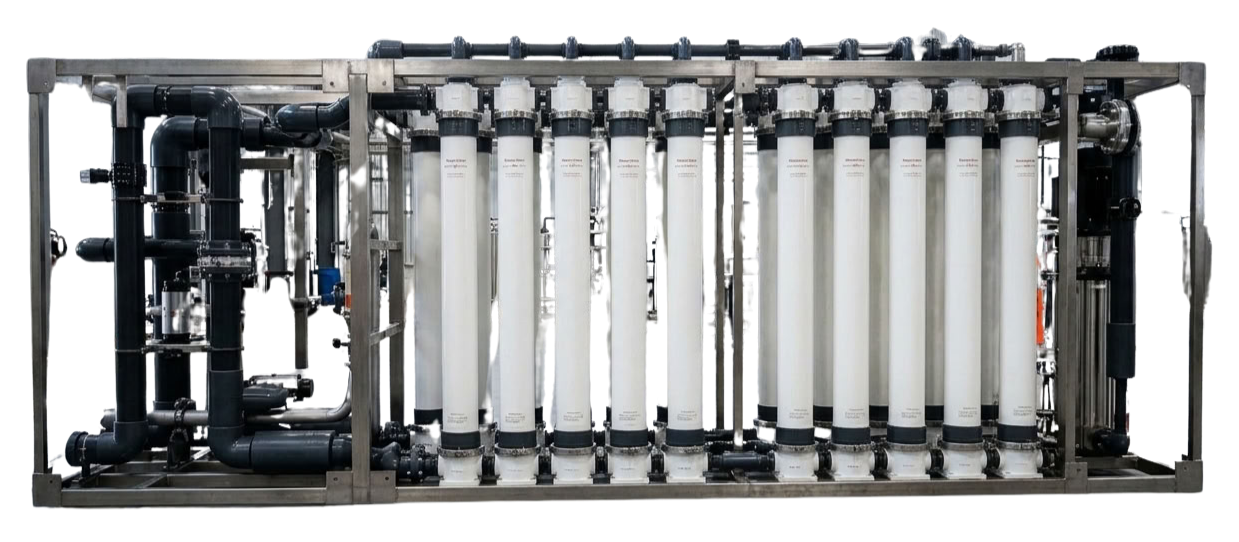
What is ultrafiltration?
Ultrafiltration (UF) is a membrane barrier that removes suspended solids, colloids, bacteria and many viruses by size. It is used as pretreatment for reverse osmosis, as tertiary polishing after biology and as a direct treatment step for reuse.
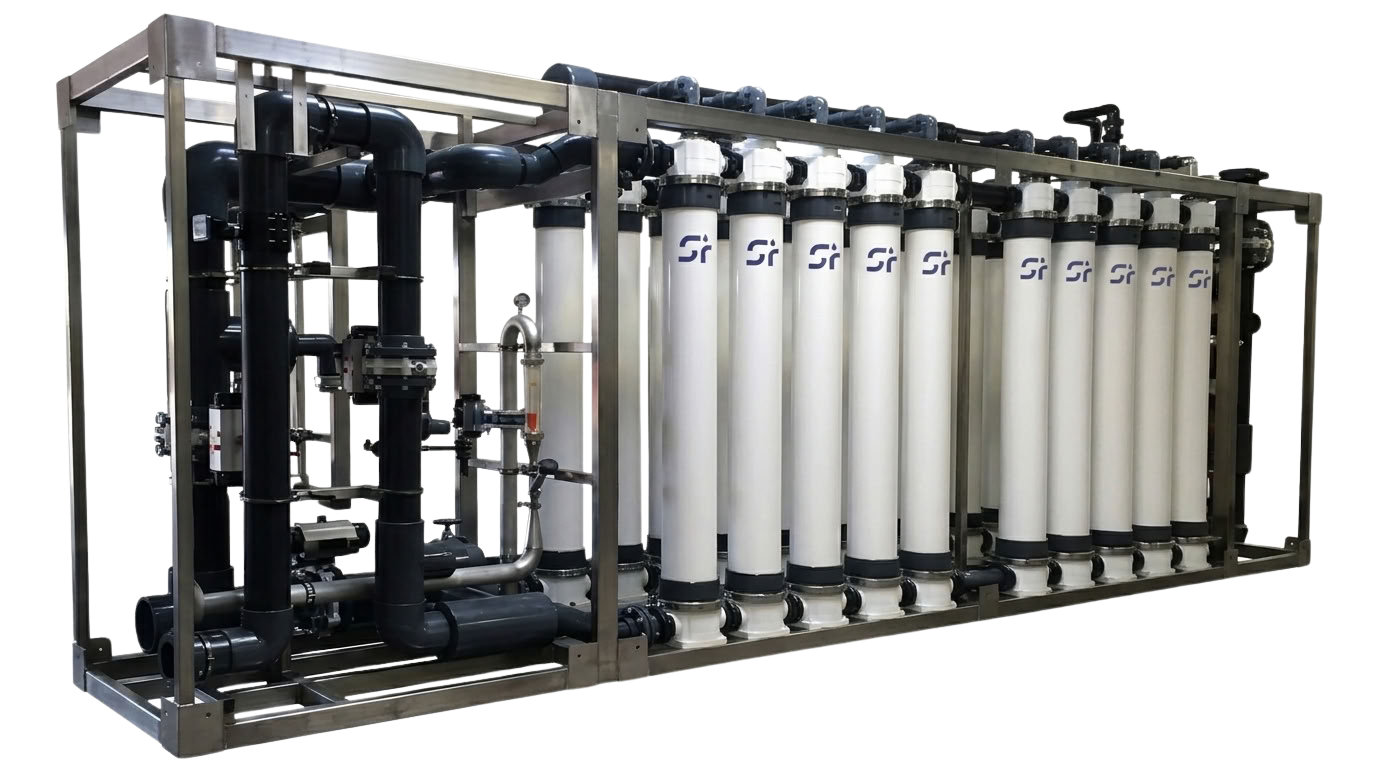
SR Paryavaran Engineers manufactures MBR, UF, RO and UHP membranes in-house and delivers UF on EPC, DBO or O&M terms.
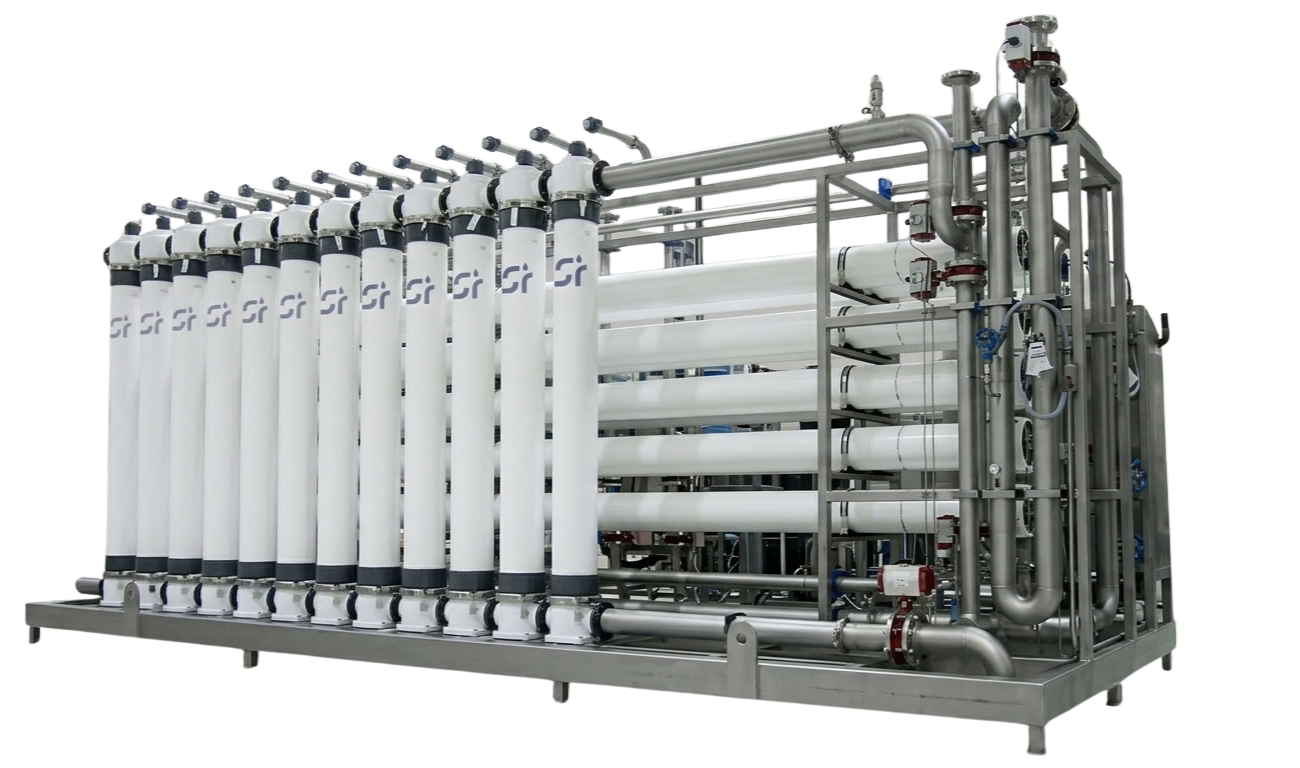
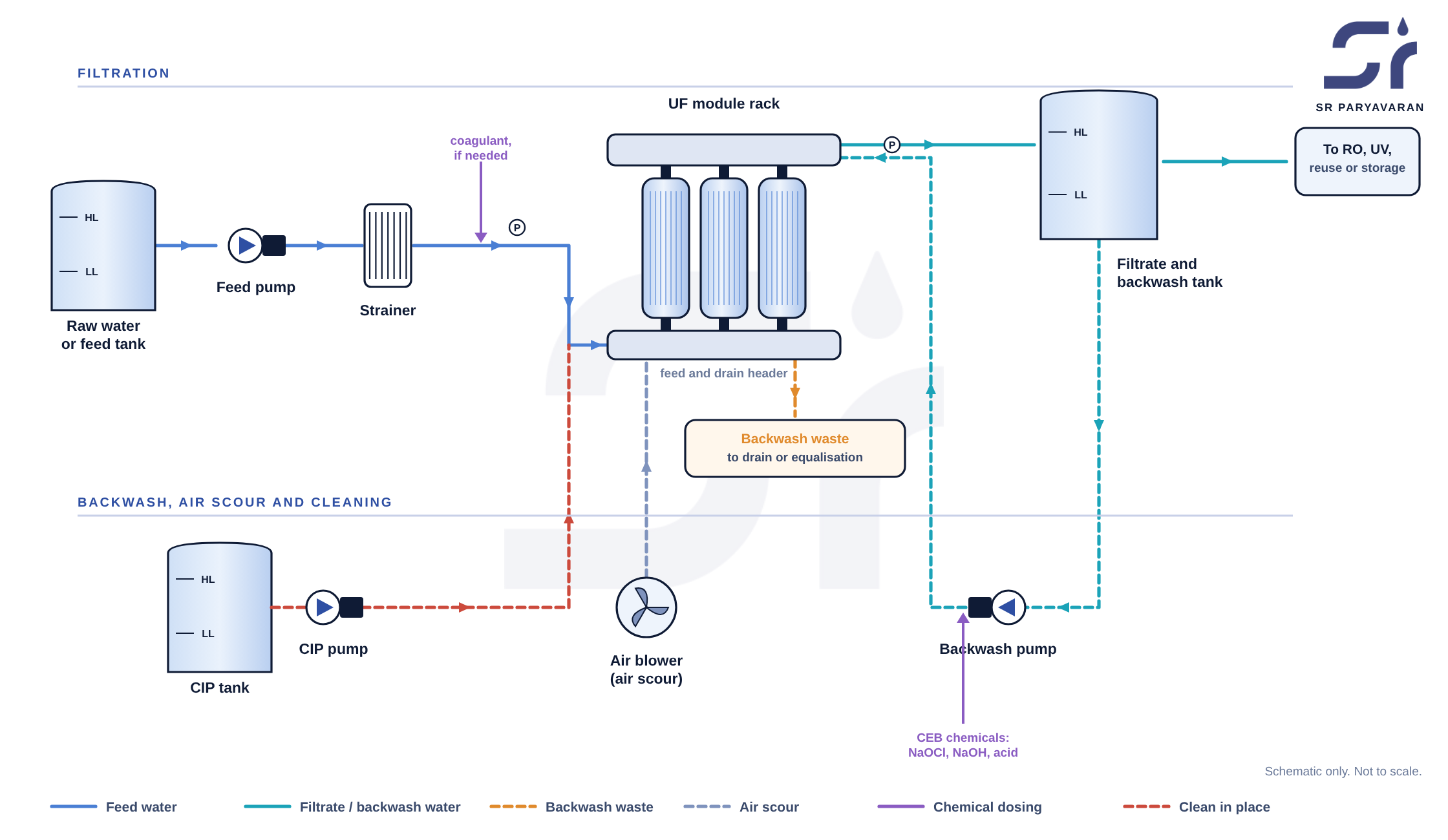
Filter, then backwash: one repeating cycle
A cross-section of one hollow-fibre capillary. Watch what the pores do in each mode, or let the cycle run on its own.
- 0.03 µmNominal pore size, SRP ULTRAFLO 4000
- 15 to 60 minTypical interval between backwashes
- 30 to 120 sBackwash duration, at 1.5 to 2.5 times filtrate flux
- At least dailyChemically enhanced backwash, 2 to 20 minutes
Operating figures are typical values from the SRP ULTRAFLO datasheet. Intervals and fluxes are set for each project. The animation is a schematic with compressed time.
What sets the UF design
The feed decides the configuration, flux and cleaning programme.
| Parameter | What it governs | Why it matters |
|---|---|---|
| Feed source and turbidity | Pretreatment and module type | Surface water, secondary effluent and seawater each need a different approach. |
| Design flux | Membrane area | A conservative flux lengthens cleaning intervals; an aggressive one raises fouling. |
| Recovery | Water efficiency | Backwash water use is balanced against filtrate recovery. |
| Temperature | Viscosity and flux | Colder water needs more area for the same flow. |
| Cleaning regime | Uptime and chemical use | Backwash frequency and chemically enhanced cleaning are set from the feed. |
| Downstream duty | Required filtrate quality | RO feed targets SDI; reuse targets turbidity and microbial reduction. |
Hollow-fibre, submerged or tubular?
| Configuration | Best for | Strength | Limitation |
|---|---|---|---|
| Pressurised hollow-fibre | RO pretreatment, clean surface or treated water | Compact, large area per module | Less tolerant of high solids |
| Submerged hollow-fibre | Tertiary and MBR duties | Air-scoured, handles variable solids | Needs a membrane tank |
| Tubular UF | Oily, high-solids or difficult feeds | Robust, easy to clean | Larger footprint and energy use |
| Spiral-wound UF | Process streams and concentration | Compact for specific duties | Needs cleaner feed |
Where UF is used
One barrier, many duties.
How SRPEPL delivers a UF system
Six steps from feed data to stable filtrate.
Engineering backed by manufacturing
Frequently Asked Questions
Ultrafiltration Systems — common questions
Ultrafiltration is a membrane process that removes suspended solids, colloids, bacteria and many viruses by passing water through a membrane with very small pores, typically in the range of about 0.01 to 0.1 micron.
UF delivers a consistent, low-turbidity and low-SDI feed regardless of fluctuations in the raw water. This reduces fouling of the RO membranes, stabilises their performance and lowers cleaning frequency.
UF systems run periodic backwash cycles, often with air scouring, and scheduled chemically enhanced backwashes. A deeper clean-in-place is carried out when the pressure drop or flux indicates it.
Hollow-fibre UF packs a large membrane area into a compact module and suits relatively clean feeds. Tubular UF tolerates higher solids and oily feeds and is easier to clean, but needs more space and energy for a given flow.
No. UF does not remove dissolved salts or small dissolved organics. For desalination or high-purity water it is followed by reverse osmosis.
Yes. SR Paryavaran Engineers manufactures MBR, UF, RO and UHP membrane elements in-house and engineers UF systems around them, delivered on EPC, DBO or O&M terms.
Send your feed water data for a UF assessment
Share the feed source, flow, turbidity or SDI and the target use. Our engineers will recommend the UF type, flux and cleaning regime.
Related