

Overview
What is a packaged STP, and why build it in a factory?
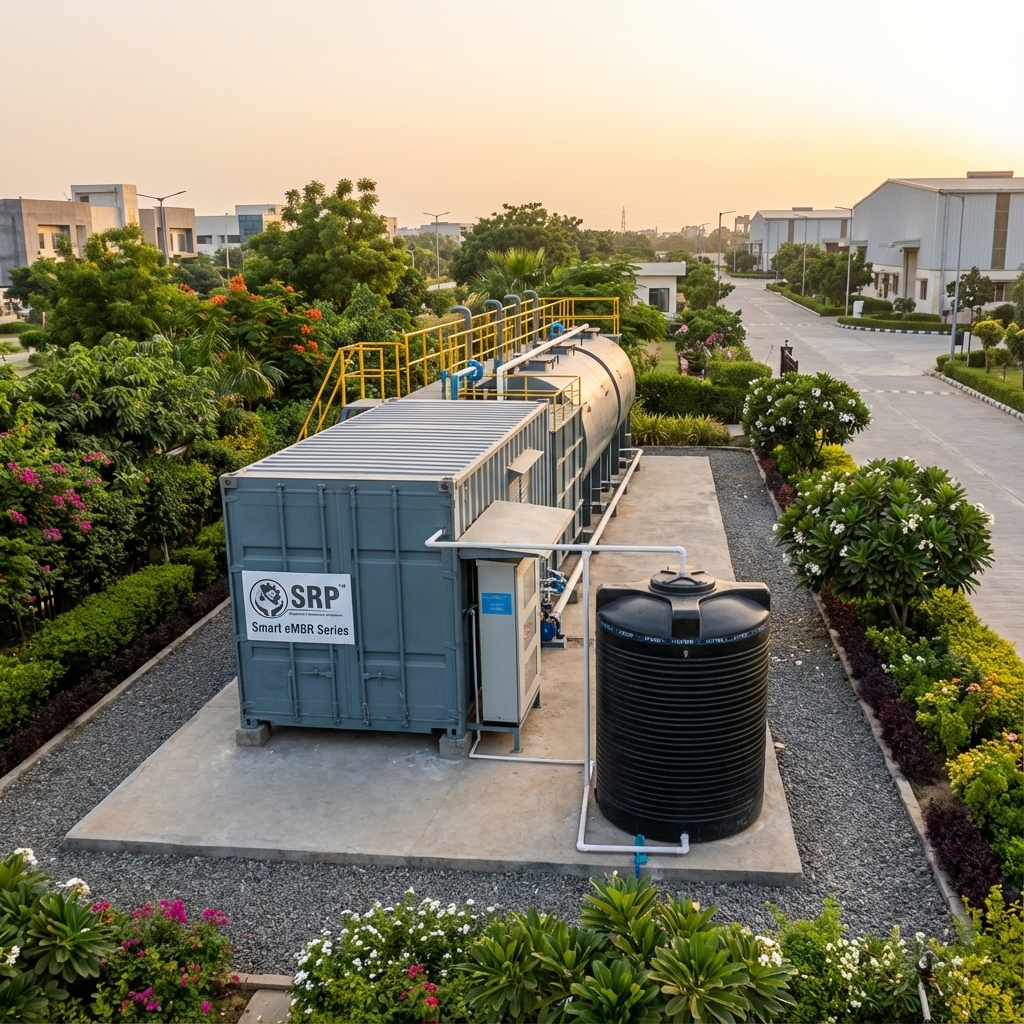
A packaged sewage treatment plant is a complete, pre-engineered plant delivered as skids or containers. A prefabricated STP is one fabricated off site in modules and assembled at the location. SRPEPL's units are both: the screen, equalisation, biology, MBR (membrane bioreactor) and disinfection are piped, wired and tested in the factory, then delivered ready to connect. The pre-engineered range runs from 10 to 500 KLD, and larger plants are engineered per project, often as several modules.
The reason to choose one is speed and certainty. Civil work shrinks to a foundation and connections, quality is checked under factory conditions instead of on a muddy site, and the plant is typically ready 8 to 16 weeks from order. The membranes replace the secondary clarifier, so the plant is compact and the treated water comes out with BOD and TSS of 5 mg/L or less and turbidity below 1 NTU, fit for flushing, gardening and other reuse.
Treatment Train
How does a packaged MBR sewage treatment plant work?
Sewage passes a screen, is evened out in an equalisation tank, treated by bacteria in the anoxic and aeration zones, then drawn through submerged membranes and disinfected. Choose a capacity and a stage below. The lower panel shows what happens inside it, down to the particles.
50 KLD · Whole plant
Schematic only. Pre-engineered units run from 10 to 500 KLD; the module count and layout shown here are illustrative and are fixed for each project from the flow, the site and the treated-water specification. Inflow curve, organic-load profile and UV doses are illustrative.
Choosing the Format
Packaged STP or a site-built plant: which is right?
Both can reach the same treated-water quality. The difference is in time, civil work, flexibility and the flow where each makes sense.
| Factor | Packaged and prefabricated | Site-built civil plant |
|---|---|---|
| Time to commissioning | About 8 to 16 weeks from order for the pre-engineered range | Set by the civil programme, and usually longer |
| Civil work on site | Foundation or hardstand and connections | Excavation and construction of every tank |
| Quality control | Fabricated, piped, wired and tested in the factory | Built on site, so it depends on site workmanship |
| Footprint | Compact, with stacked or containerised layouts | Set by tank geometry and the available land |
| Relocation | A skid or container can be moved if the site changes | Fixed once built |
| Expansion | Add a module beside the first | New civil works |
| Capacity | 10 to 500 KLD pre-engineered; multi-module above that | Practical for very large flows, in MLD |
| Best suited to | Campuses, hotels, hospitals, townships, camps, remote and fast-track sites | City-scale plants where land is available and flows are large |
Choosing the process. MBR is the standard SRPEPL packaged format because it delivers reuse-grade water in a small footprint. Where the discharge norm is moderate and reuse is not planned, a simpler biology such as extended aeration or MBBR can be compared against it. SRPEPL's process team runs that comparison for the specific case rather than assuming MBR. For the full range of STP technologies, see the sewage treatment plant page.
Sizing
How do you size a packaged STP?
The plant is sized from the people it serves. Multiply the occupancy by the water use per person for the building type, take about 80% of that as sewage, and add a margin for growth and peaks. Try it below.
Indicative only. Per-person values follow the NBC and IS 1172 norms commonly used for design; confirm against the code edition and local bye-laws for your approval. Process engineers set the final size from the peak flow, the load and the treated-water target.
Sizing a packaged STP?
Send the occupancy or flow and the location. We will call you.
Thank you.
We have received your enquiry. Our team will contact you to discuss your plant and the next steps.
Prefer to talk first? WhatsApp us
The Membrane
AEROFLO flat-sheet MBR membranes, made in-house
The membrane is the heart of a packaged MBR plant. SRPEPL's sister division, SRP Membranes, makes the AEROFLO corrugated PVDF flat-sheet membrane at Panchkula and Baddi, so the plant and its membrane come from one accountable source.
| Item | AEROFLO specification |
|---|---|
| Membrane | Corrugated PVDF flat sheet on a PET support board, with an independent channel for water collection |
| Nominal pore size | 0.1 µm |
| Thickness and weight | 1.6 mm thick, 0.84 kg per m² |
| Design effect of the corrugation | Local turbulence that resists fouling, and higher load-bearing capacity than conventional flat sheet |
| Energy | 10 to 15% lower than traditional flat membranes, per SRP Membranes data |
| Backwash flux | 15 to 30 L/m²·h |
| Cleaning | Sodium hypochlorite and citric acid |
| Modules | FC-A-6 (9 m²), FC-B-6 (11 m²), FC-B-8 (15 m²), FC-C-6 (5 m²), FC-D-6 (7 m²) |
Full datasheets are published at srpmembranes.com. Module choice and the number of modules in a plant are set from the design flux and the peak flow.
Applications
Where are packaged and prefabricated STPs used?
Apartment blocks and gated communities that need an STP with a small footprint and reusable water for flushing and gardens.
Steady, high-quality treated water for landscaping and flushing, with the plant kept out of sight.
Campuses where uptime and clean, low-odour operation matter, and where treated water offsets a large demand.
Commercial campuses that must show water-reuse performance as well as meet discharge norms.
Formations that need MES-grade specifications, security-cleared access and fast deployment.
Rest areas, stations and construction camps with no sewer, short timelines and shifting locations.
Canteen and toilet sewage from factories, kept separate from process effluent.
An extra module beside an overloaded or ageing STP, or an MBR retrofit into an existing tank.
Delivery
From order to treated water in about 8 to 16 weeks
The saving comes from running the work in parallel: the foundation is prepared on site while the plant is built and tested in the factory. The exact programme depends on capacity, approvals and site readiness.
Flow, load and treated-water target are fixed. Layout, process and utility needs are issued for approval.
Tanks, screens, blowers, MBR modules, pumps and panels are fabricated, piped, wired and tested before they ship.
Skids or containers are delivered to site and set on the prepared foundation, then connected to inlet, outlet and power.
The biology is seeded, the membranes are brought on line, performance is verified and the operators are trained.
Scope and Contracts
What is included, and how can it be contracted?
A typical split is shown below. The exact scope is stated in the offer for each project.
SRPEPL scope, typically
- Process design and general arrangement
- Skids or containers with tanks, screen, blowers and pumps
- AEROFLO MBR modules and permeate suction system
- UV or chlorine disinfection
- MCC and PLC control panel, instruments and piping
- Factory testing, installation supervision, commissioning and operator training
Client scope, typically
- Foundation or hardstand for the plant
- Raw sewage inlet and treated-water outlet connections
- Power supply and a drain for excess sludge
- Statutory approvals and consents for the site
Contract models. SRPEPL supplies packaged plants on an EPC basis, and also under DBO and annuity contracts of 3 to 10 years where it designs, builds and operates the plant. Operation and maintenance contracts are available for plants SRPEPL has supplied and for existing plants, supported by five regional offices. See O&M and DBO services.
Track Record
450+ packaged MBR units delivered across India
SRPEPL has delivered more than 450 packaged MBR systems from 10 to 500 KLD for institutional campuses, defence formations, residential projects, commercial sites, construction camps and highway rest areas. Defence and AWHO installations are built to military engineering specifications with security-cleared access and fast-track commissioning. SRPEPL operates from Panchkula and Baddi manufacturing sites and holds ISO certifications.
Frequently Asked Questions
Packaged and prefabricated STPs: common questions
A packaged sewage treatment plant is a complete, pre-engineered treatment system built in a factory and delivered to site ready to connect. It holds the screen, equalisation, biological treatment, solids separation and disinfection in skid-mounted or containerised modules, so the work on site is mainly placement, piping, power and commissioning. SRPEPL packaged plants use an MBR (membrane bioreactor) process with in-house AEROFLO flat-sheet membranes.
The two terms overlap. Packaged usually means the plant is pre-engineered as a standard, complete unit. Prefabricated means the plant is fabricated off site in modules, such as skids or containers, and assembled at the location. The SRPEPL range from 10 to 500 KLD is both: pre-engineered sizes, fabricated and tested in the factory.
SRPEPL offers pre-engineered packaged STPs from 10 KLD to 500 KLD. Above 500 KLD the plant is engineered on a project basis, often as several modules in parallel, and can be combined with site-built tanks where that suits the flow and the land.
About 8 to 16 weeks from order for the pre-engineered range, depending on capacity, approvals and site readiness. The time is shorter than a site-built plant because fabrication and testing in the factory run alongside site preparation.
Minimal. The site usually needs a foundation or hardstand, the raw sewage inlet, the treated-water outlet, a power supply and a drain for sludge. There is no full tank construction, which is what saves the time. The exact civil scope is stated in the offer for each project.
The MBR output is BOD of 5 mg/L or less, TSS of 5 mg/L or less and turbidity below 1 NTU. With disinfection, this suits flushing, gardening, landscaping and similar reuse. If cooling-tower makeup, boiler feed or process water is the goal, a tertiary UF and RO stage can be added downstream.
No. The membranes replace the secondary clarifier and separate the biomass from the water directly. That is one reason the plant is compact, and why the treated water has such low suspended solids and turbidity.
Start from the occupancy and the water use per person for the building type, as set out in the NBC and IS 1172. Sewage is commonly taken as about 80% of the water supplied. Add a margin for growth and peaks, then choose the nearest pre-engineered size. The sizing calculator on this page gives a first estimate, and the SRPEPL process team confirms it against your site data.
Yes, within limits. Capacity can be added by installing another module alongside the first, and a skid or container can be moved if the site changes. Whether a specific unit should be expanded or relocated is checked against its hydraulics and layout.
The owner can run it with trained operators, or SRPEPL can operate it under an O&M or DBO contract. DBO and annuity terms run from 3 to 10 years, and five regional offices support plants after commissioning.
The cost depends on the capacity, the treated-water specification, the format (skid, container or multi-module) and the site. Send the flow or occupancy, the location and the discharge or reuse target with an enquiry, and the SRPEPL team will return an indicative scope and budget.
Sizing a packaged STP?
Send the occupancy or flow and the location. We will call you.
Thank you.
We have received your enquiry. Our team will contact you to discuss your plant and the next steps.
Prefer to talk first? WhatsApp us
Related Solutions