

Technical insight / Industrial water reuse
How better tertiary treatment can reduce evaporator load in ZLD systems
A well-designed tertiary treatment plant can enable higher sustainable membrane recovery, improve industrial water reuse and reduce the concentrate sent to evaporation.
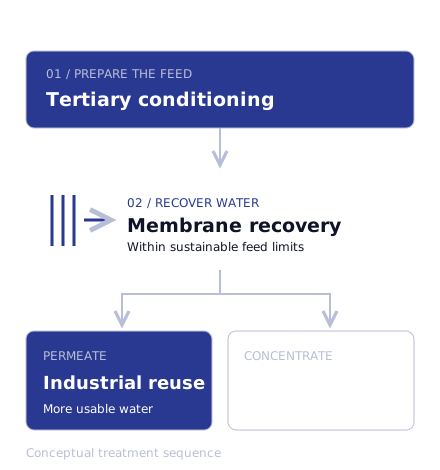
Before investing in a larger evaporator, establish how much more water can be economically recovered through membranes.
The opportunity depends on feed chemistry, pretreatment, membrane selection and system design. For an existing ZLD plant, improving recovery upstream may reduce thermal operating costs or release treatment capacity. For a new plant, it can reduce the thermal duty that must be installed.
What is a tertiary treatment plant, and why does it matter for industrial reuse?
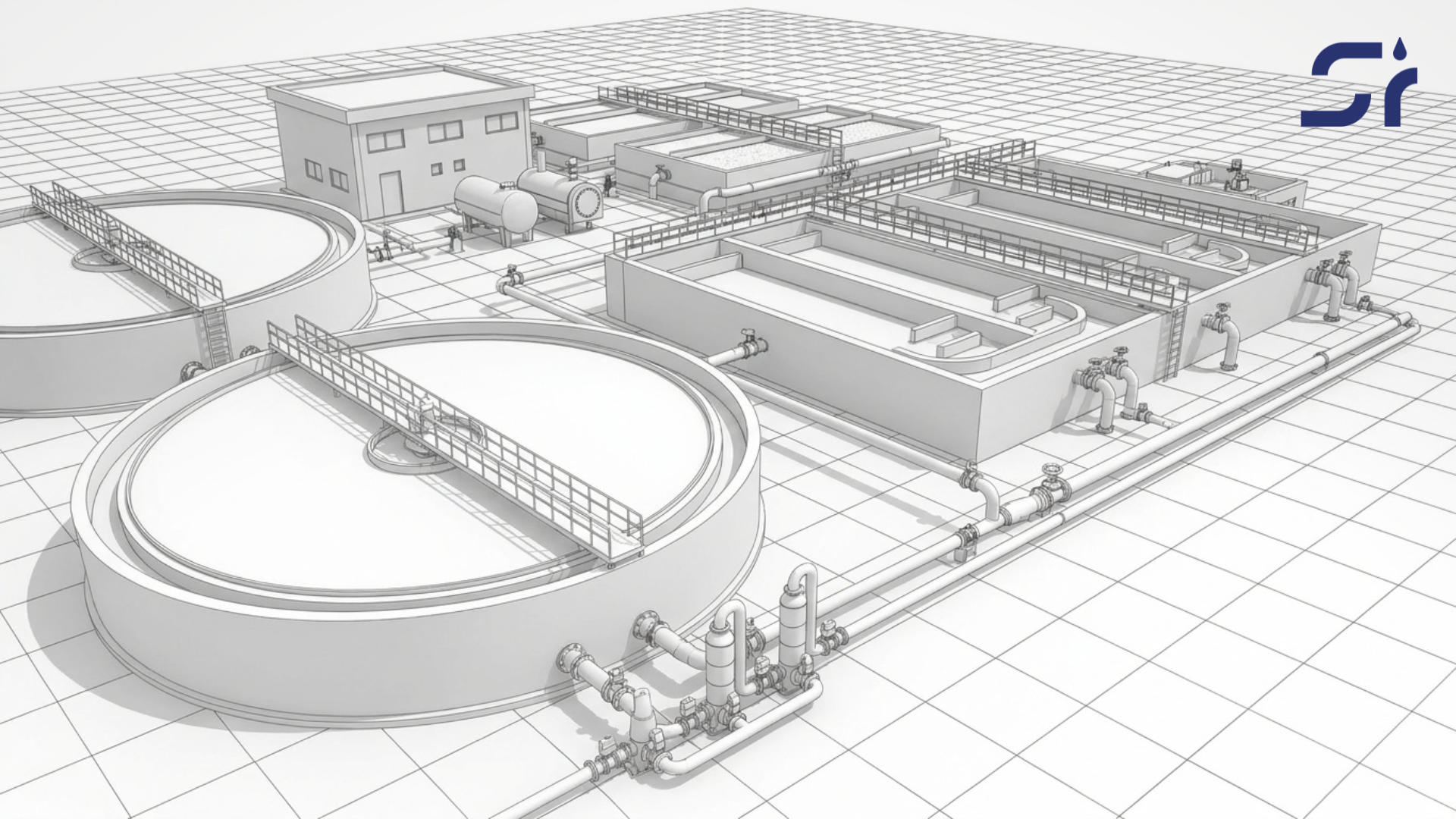
A tertiary treatment plant provides further treatment after primary and secondary treatment to produce water suitable for its intended reuse or downstream process.
Depending on the application, it may incorporate filtration, ultrafiltration, chemical conditioning, softening, reverse osmosis and disinfection. The treatment train must address the actual contaminants and required product-water quality.
Cooling-tower makeup, process water, washing water and feed to a boiler-makeup treatment system have different requirements. A TTP should therefore be specified against a defined reuse destination.
In a ZLD system, tertiary treatment and membrane recovery have an additional responsibility: recover usable water while controlling the volume and chemistry of the concentrate sent to thermal treatment.
Explore SR Paryavaran’s tertiary treatment solutions →How does tertiary treatment influence RO recovery?
RO recovery is the proportion of feed water recovered as permeate. Sustainable recovery depends on more than the membrane’s nominal performance.
Suspended solids, colloids, residual organics, hardness, silica and other scale-forming constituents can limit operation. Their effects become more significant as water is recovered and the remaining contaminants become concentrated.
Effective pretreatment helps the membrane system operate within its design limits. Different processes address different problems: UF controls suspended and colloidal material, while dissolved scaling constituents may require chemical conditioning, softening or other targeted treatment.
Raising the recovery setpoint without addressing the limiting chemistry can increase scaling, fouling and cleaning frequency rather than improve plant economics. [1]
Why recover water through membranes before evaporation?
Membranes separate water under pressure without boiling it. Evaporation requires a phase change, although multiple effects and vapour recompression recover and reuse energy.
Within a suitable operating envelope, membrane recovery generally requires less energy than thermal concentration. Recovering additional water upstream can therefore reduce the volume requiring energy-intensive thermal treatment. [2] [3]
Maximise economically sustainable membrane recovery, then thermally treat the remaining concentrate.
That decision must account for additional membrane power, pretreatment, chemicals, cleaning, replacement costs and achievable uptime. More recovery is valuable when the total lifecycle economics support it.
An illustrative example
How much can higher RO recovery reduce evaporator feed?
The relationship is straightforward:
Membrane concentrate flow = membrane feed flow × (1 − overall membrane recovery).
Use recovery as a fraction: 75% = 0.75.
Consider an illustrative system receiving 1,000 m³/day into its membrane-recovery section:

| Parameter | Existing operation | Illustrative improvement |
|---|---|---|
| Feed to membrane-recovery section | 1,000 m³/day | 1,000 m³/day |
| Overall membrane recovery | 75% | 90% |
| Recovered permeate | 750 m³/day | 900 m³/day |
| Concentrate sent to thermal treatment | 250 m³/day | 100 m³/day |
less concentrate sent to thermal treatment
A 15-percentage-point recovery increase reduces thermal feed by 150 m³/day in this example.
This is an illustrative water balance, not a performance guarantee. It assumes unchanged feed flow, all membrane concentrate entering thermal treatment, and excludes other losses and side streams.
The retained salt load becomes more concentrated. A 60% reduction in thermal feed does not automatically mean a 60% reduction in evaporator size, energy consumption or cost. Actual duty depends on the revised brine properties, final concentration, solids handling and equipment operating limits.
Can a three-to-five-year-old ZLD plant benefit from newer membrane technology?
Potentially, yes. A plant installed three to five years ago may merit reassessment against current membrane options, its actual feed and present operating requirements.
Membrane and element designs continue to develop for challenging wastewater and higher-concentration brine service. These options may allow additional recovery in suitable applications, but benefits must be established for the complete treatment train. [4]
A retrofit assessment may identify opportunities to:
- Improve pretreatment or remove a specific scaling constraint.
- Replace unsuitable or deteriorated membrane elements.
- Optimise staging, flux distribution and controls.
- Add a dedicated reject-recovery stage.
- Segregate incompatible wastewater streams.
A new membrane is not automatically a drop-in replacement. Pressure vessels, pumps, piping, instruments and operating limits must support the proposed configuration.
Plant age is a reason to review performance—not evidence that an upgrade will necessarily deliver savings.
What changes for existing and new evaporators?
Existing installation
Assess capacity headroom
Lower feed volume may ease a capacity bottleneck, reduce utility demand or accommodate production growth. The revised concentrate must remain compatible with the equipment’s chemistry and turndown limits.
New installation
Size the residual duty
Establishing feasible membrane recovery first provides a sound basis for thermal sizing. This can avoid installing unnecessary evaporation duty while retaining appropriate operating margins.
The tertiary, membrane and thermal sections should be assessed together through an integrated water, salt and energy balance.
Explore SR Paryavaran’s ZLD solutions →Relevant project experience
What relevant project experience does SR Paryavaran bring?
SR Paryavaran’s relevant project experience includes:
Integrated steel unit
TTP + ZLD
4-stage ROLarge-scale TTP + ZLD plant incorporating a four-stage RO system.
Supercritical thermal power
Tertiary treatment
300 m³/hThree-stage tertiary treatment plant for a supercritical thermal power plant.
These references provide context for discussing industrial reuse, staged membrane treatment and integration with downstream systems.
The appropriate configuration for another facility must be established from its own feed characteristics, reuse requirements and operating constraints.
Your questions, answered
Frequently asked questions
Is tertiary treatment the same as ZLD?
No. Tertiary treatment prepares water for a specified quality or reuse application. ZLD addresses the complete liquid-effluent boundary, including management of membrane concentrate and residual streams. A TTP can form a critical part of a ZLD system.
Can upgrading the RO section eliminate the evaporator?
Not necessarily. Additional membrane recovery can reduce thermal feed, but the remaining concentrate still requires an appropriate treatment or management route. Eliminating evaporation cannot be assumed from recovery improvement alone.
Does adding more RO stages always increase recovery?
No. Additional stages help only when feed chemistry, membrane selection, pressure availability and hydraulic design permit sustainable additional recovery. Staging alone does not remove scaling or osmotic-pressure limits.
What information is needed for an initial assessment?
Start with available feed and reject analyses, plant flow, current recovery, operating pressures, cleaning frequency, evaporator feed and utility consumption. Incomplete information can support an initial discussion; further sampling or testing can then be defined.
Start with your actual feed
Request your personalised Treatability Study™
Could your existing plant recover more water before evaporation?
Contact SR Paryavaran for your personalised Treatability Study™. Share your available water analysis, plant configuration and operating challenges.
The assessment can establish the feasible recovery range, potential reduction in thermal feed, required modifications and investment economics, with laboratory or pilot testing where necessary.
SR Paryavaran Engineers (P) Ltd.Remember the Future
Recover more usable water. Reduce avoidable thermal duty.
Technical references
- The Global Rise of Zero Liquid Discharge for Wastewater Management: Drivers, Technologies, and Future Directions. Environmental Science & Technology, 2016. Background on integrated treatment and pretreatment constraints.
- High-Pressure Reverse Osmosis for Energy-Efficient Hypersaline Brine Desalination: Current Status, Design Considerations, and Research Needs. Environmental Science & Technology Letters, 2018.
- Thermodynamics and Energy Efficiency of Zero Liquid Discharge. ACS ES&T Engineering, 2022.
- DuPont FilmTec™ Fortilife™ membrane portfolio. Manufacturer information illustrating available wastewater and brine-recovery membrane options; not a specification or performance guarantee for an SRP project.